BEST Funeral Directors – KNOW YOU’RE IN GREAT CARE
Burial funerals: a personal farewell and a lasting place to remember
A burial funeral gives family and friends a place to come together, say goodbye and lay the person who has died to rest.
For some families, burial follows a long-standing religious or cultural tradition. Others value having a grave they can visit, tend and return to over the years. There may already be a family grave, a connection with a particular churchyard or simply a wish to be buried close to home.
Best gives you a clear place to begin. We will explain what needs to happen and instruct the carefully selected local Best Funeral Director for your area. The local team will check the burial options, coordinate the funeral and care for your loved one through their own established local business.
Enter your postcode to see the Best Funeral Director we have carefully selected in your area. Or call us on 0333 242 2368.
What is a burial funeral?
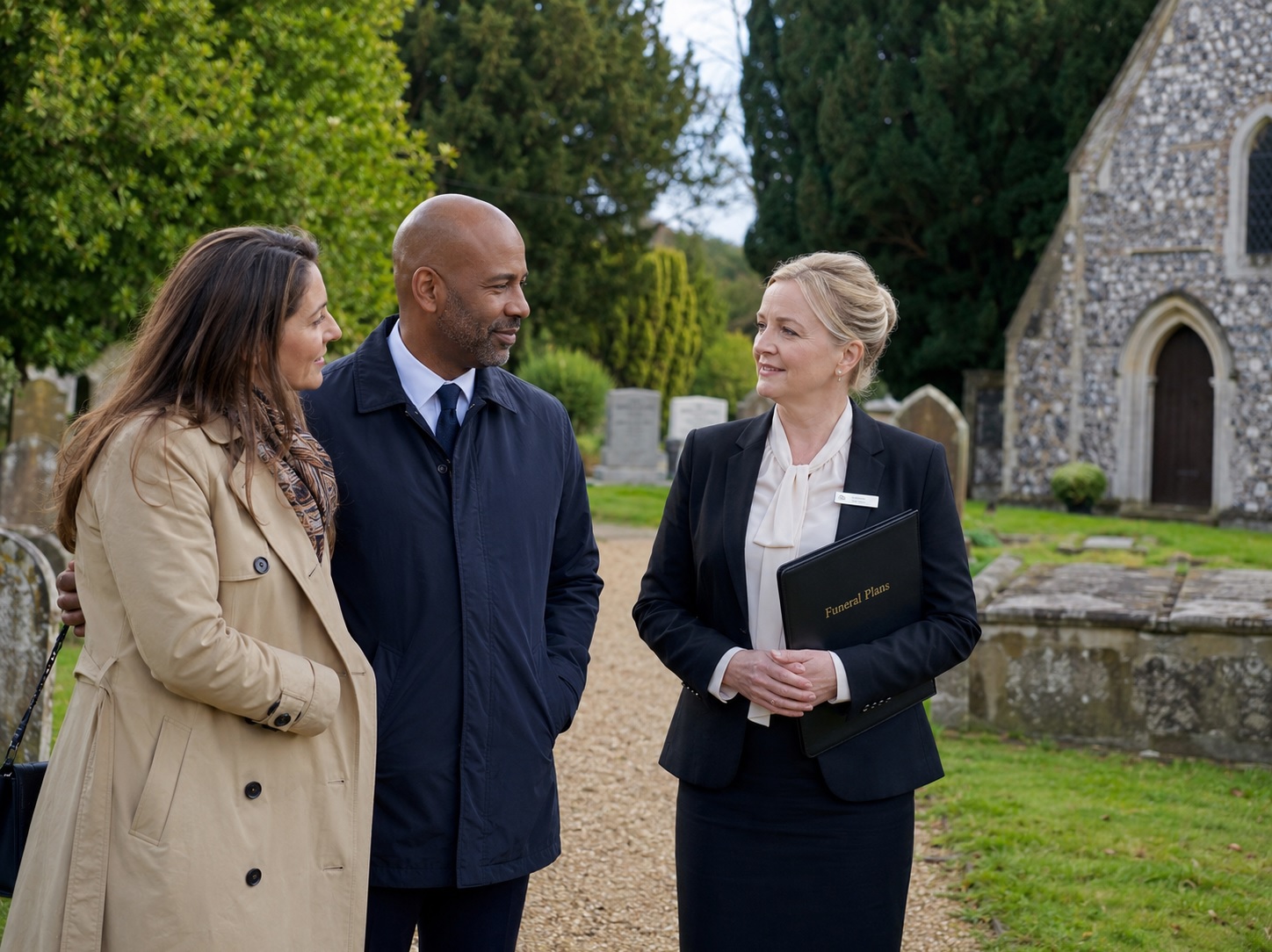
A burial funeral is an attended funeral followed by the burial of the coffin in a grave.
The ceremony may take place:
- in a church or another place of worship;
- in a cemetery chapel;
- at a funeral home with suitable service facilities;
- in another appropriate venue;
- entirely at the graveside;
- or across two locations, with a service first and the committal at the grave afterwards.
A burial funeral commonly includes:
- professional care of the person who has died;
- a coffin;
- a hearse or suitable funeral vehicle;
- an attended ceremony;
- music, prayers, readings or tributes;
- the funeral procession;
- preparation of the grave;
- the graveside committal;
- and decisions about a memorial or headstone later.
Burial may take place in a council cemetery, private cemetery, churchyard, natural burial ground or another burial ground accepting the interment. Availability and eligibility rules vary between sites.
Why do families choose burial?
Families choose burial for many different reasons.
A permanent place to visit
A grave can become a lasting place for relatives and friends to visit, leave flowers and remember the person who has died.
Faith and cultural traditions
Burial is central to the funeral traditions of several faiths and cultures. Religious requirements may influence how quickly the burial takes place, how the person is cared for, the type of coffin or shroud used and what happens at the graveside.
An existing family grave
There may already be space in a grave containing a partner, parent or another family member.
The cemetery or churchyard will need to confirm that the grave can be reopened and that the correct person has authority to approve the burial.
A connection with a place
Some people want to be laid to rest in the community where they lived, close to relatives or in a churchyard connected with their family.
A preference for a natural setting
Natural and woodland burial grounds offer a different style of farewell, often using biodegradable materials and a more informal landscape instead of a traditional cemetery and headstone.
There is no universally right choice between burial and cremation. The decision may be guided by the person’s wishes, family tradition, faith, cost and the availability of local burial space.
Start making funeral arrangements
One call to Best gives you clear guidance and trusted local care.
Call 0333 242 2368 to arrange a Best Funeral. We will explain the next step and instruct the Best Funeral Director selected for your area.
What happens at a burial funeral?
Every service has its own character, although the day often follows a familiar sequence.
1. The funeral procession begins
The hearse may leave from the funeral home, collect close relatives from a family address or meet everyone at the service venue.
The route can pass a home, workplace, club or another place connected with the person’s life.
2. The main ceremony takes place
The service might be held in a church, chapel or another suitable venue.
It can include:
- a welcome;
- hymns or other music;
- prayers or reflective words;
- readings;
- a eulogy;
- contributions from relatives and friends;
- quiet reflection;
- final words before leaving for the grave.
A shorter ceremony may instead take place entirely at the graveside.
3. The procession travels to the burial ground
Where the main service happens elsewhere, the hearse and family vehicles travel to the cemetery or churchyard.
The funeral director coordinates the route, arrival and movement to the grave.
4. The graveside committal takes place
The coffin is carried to the grave and usually lowered during or shortly after the final words.
Depending on the ceremony, people may place a flower, handful of earth or another suitable tribute at the grave.
5. Family and friends gather afterwards
Many families hold a wake or reception at home, in a pub, hotel, community hall or another familiar venue.
A burial ceremony is commonly held after the main funeral service, with mourners attending the graveside as the coffin is lowered.
Can a burial funeral be personalised?
Yes. Burial provides plenty of room for personal choices, both during the main ceremony and at the graveside.
You might include:
- favourite music;
- hymns or prayers;
- a family-written eulogy;
- poems or readings;
- photographs;
- relatives acting as pallbearers;
- a procession past a meaningful place;
- flowers placed on or beside the coffin;
- a handwritten note or suitable personal item;
- family members placing earth or flowers into the grave;
- a gathering in a familiar local venue afterwards.
The grave itself may later be marked with a headstone, plaque or another form of memorial permitted by the burial ground.
Cemeteries and churchyards have their own rules about memorial size, materials, wording and installation. It is sensible to wait until those rules have been checked before ordering anything.
A personal burial funeral does not need a long list of additions. A familiar hymn at church, a few honest words beside the grave or a route through the person’s neighbourhood may carry most of the meaning.
You can read more in our article about personalising a funeral.

How much does a burial funeral cost?
Burial is commonly more expensive than cremation because the final cost may include purchasing burial rights, preparing the grave and paying cemetery or churchyard fees.
SunLife’s 2026 research found an average cost of £4,758 for a simple attended burial and £5,440 for a traditional attended burial. These are national averages, and individual prices vary considerably by area, cemetery and funeral arrangements.
A burial funeral quotation may include:
Funeral director charges
- arranging and conducting the funeral;
- bringing the person who has died into care;
- professional care;
- the coffin;
- staff and pallbearers;
- the hearse;
- family transport;
- funeral administration.
Burial fees
- purchasing the Exclusive Right of Burial;
- opening or reopening the grave;
- cemetery or churchyard charges;
- non-resident supplments;
- grave-lining or shoring where required.
Other third-party costs
- minister or celebrant fees;
- church or venue charges;
- organist or musician fees;
- newspaper notices;
- flowers;
- printed orders of service.
Later memorial costs
- the headstone or memorial;
- cemetery permit fees;
- inscription and installation;
- future maintenance or additional lettering.
Government guidance confirms that funeral costs can include funeral-director fees, third-party payments and local-authority burial charges. Funeral directors are also legally required to publish standard pricing information.
Ask for:
- the Standardised Price List;
- the Additional Options Price List;
- the burial-fee range for the local area;
- a written, itemised quotation;
confirmation of resident and non-resident charges; - an explanation of later memorial costs.
The CMA requires funeral directors offering burial funerals to show the local range of burial fees on their Standardised Price List.
Best focuses on proper local care and fair, transparent value. The burial funeral is delivered according to the local Best Funeral Director’s services and price list, shaped around the choices your family makes.

Understand burial funeral costs in your area
Call Best on 0333 242 2368 and We will explain the next steps and instruct the local Best Funeral Director to check nearby burial options, current fees and grave availability.
Why local knowledge matters for a burial funeral
Burial arrangements are closely tied to local places and local rules.
A funeral director may need to coordinate with:
- council cemetery teams;
- churchwardens and clergy;
- private burial grounds;
- grave diggers;
- stonemasons;
- natural burial sites;
- faith and community representatives;
- registration and medical professionals.
They may also need to trace a family grave, confirm ownership documents, check whether a churchyard accepts the burial and arrange the journey between the service and graveside.
A local independent funeral director is well placed to handle those details because they already understand the area, the burial grounds and the people responsible for them.
Best carefully selects one local independent Best Funeral Director for each area, looking at care, professional standards, facilities, reputation and local expertise. The local funeral director then provides the arrangements through its own people, premises and established business.
The care before the graveside
Families see the procession, ceremony and final committal.
But much of the funeral director’s work has already taken place before the hearse arrives.
The local team may have:
- brought the person who died into professional care;
- completed identification and record checks;
- provided mortuary care;
- washed, dressed and prepared them;
- arranged a chapel-of-rest visit;
prepared the coffin; - checked the burial authority and paperwork;
- confirmed grave availability;
- liaised with a church, minister or celebrant;
- checked the route and timings;
- prepared the vehicles and equipment;
- briefed the pallbearers.
Best considers the people, facilities and professional procedures behind the funeral – not only the parts visible on the day.
The Best Care Promise reflects the standards expected whenever a Best Funeral is delivered, including the important care taking place when the family cannot be present.
Why arrange a burial funeral through Best?
Burial can involve more local administration than families initially expect.
There may be grave records to trace, burial rights to check, cemetery fees to understand and several venues or people to coordinate.
Best gives you one clear place to begin.
When you call:
- we listen to what has happened and what your family needs;
- we confirm the Best Funeral Director selected for your area;
- the local team checks the available burial options;
- they provide the care and funeral arrangements through their own established business;
- and Best remains available and accountable for the standards promised.
You do not need to assess a list of unfamiliar providers before the arrangements can begin.
Best has already carefully selected the independent local funeral director responsible for your area.

A final resting place deserves careful local attention
Call Best now on 0333 242 2368.
Frequently asked questions about burial funerals
Burial funerals can bring up questions about graves, cemetery rules, costs and what happens at the graveside. The answers below explain the main choices and practical steps, helping you understand what to expect before making the arrangements.
Q: What is a burial funeral?
A: A burial funeral is an attended funeral followed by the burial of the coffin in a cemetery, churchyard or other burial ground. The main ceremony may take place elsewhere before everyone travels to the grave.
Q: Can the whole funeral take place at the graveside?
A: Yes. A graveside funeral can include music, prayers, readings, a eulogy and the committal without a separate church or chapel service.
Q: Can a burial funeral be non-religious?
A: Yes. It can be led by a civil celebrant, humanist officiant, family member or another suitable person, subject to the burial ground’s rules.
Q: Can we choose any cemetery?
A: You can request a preferred cemetery, although it must have availability and accept the burial. Non-resident charges or eligibility rules may apply.
Q: Can someone be buried in an existing family grave?
A: Possibly. The cemetery will check whether there is enough space, whether the burial rights remain valid and who has authority to approve the grave being reopened.
Q: What does buying a burial plot mean?
A: In many cemeteries, you purchase the Exclusive Right of Burial for a fixed period rather than owning the land itself. The registered holder can authorise burials and memorial work under the cemetery’s rules.
Q: Who owns a grave after the registered owner dies?
A: The burial rights may need to be legally transferred before another burial or memorial work can be authorised. The cemetery office will explain which documents and family declarations are required.
Q: What happens during the graveside committal?
A: The coffin is carried to the grave and final words, prayers or reflections are given. The coffin is then lowered, and relatives may place flowers or earth at the grave if they wish.
Q: Do families watch the coffin being lowered?
A: Usually, the lowering can take place during the service, but families may discuss their preferences with the funeral director beforehand.
Q: Can relatives carry the coffin?
A: Often, yes. The funeral director will assess whether this is safe, explain the route to the grave and rehearse the process with the pallbearers.
Q: When can a headstone be installed?
A: Burial grounds commonly require a settling period before a full headstone is installed. The timing and permitted memorials vary, so check the cemetery or churchyard rules before ordering one.
Q: Is burial more expensive than cremation?
A: It often is because the price can include grave-purchase rights, grave preparation and cemetery charges. SunLife’s 2026 national averages were £4,758 for a simple attended burial and £5,440 for a traditional attended burial.
Q: What is a natural burial?
A: A natural burial usually takes place in a woodland or designated natural burial ground, often using biodegradable coffins or shrouds and lower-impact forms of memorialisation.
Q: Who can help me arrange a burial funeral?
A: Call Best on 0333 242 2368. We will explain the immediate next steps and instruct the carefully selected local Best Funeral Director for your area
Arrange a burial funeral with Best
A burial gives family and friends a place to gather on the day and somewhere they can return to in the years that follow.
Best has already carefully selected the local independent funeral director who will provide the care, check the burial options and coordinate the funeral in your area.
Enter your postcode to see the Best Funeral Director carefully selected for your area, or call Best at any time on 0333 242 2368.