BEST Funeral Directors – KNOW YOU’RE IN GREAT CARE
Affordable funerals: keeping costs down without losing what matters
An affordable funeral is not one particular package.
It is a funeral that gives the person who has died proper professional care, gives the family the kind of goodbye they need, and stays within a budget they can realistically manage.
For one family, that might mean a simple attended cremation with everyone present. For another, it might mean keeping a traditional funeral but choosing fewer vehicles, simpler flowers or a more modest coffin. For some, an unattended direct cremation followed by a separate celebration of life makes much more sense.
At Best, we help families understand those choices clearly. We carefully select independent local funeral directors for their standards, facilities, people and quality of care, as well as fair and transparent value.
Enter your postcode to see the Best Funeral Director we have carefully selected in your area. Or call us on 0333 242 2368.

How much does an affordable funeral cost?
There is no official price that makes a funeral “affordable”.
Current national averages do, however, show just how much the choices around a funeral can affect the overall cost.
| Funeral type | 2026 UK average |
|---|---|
| Direct cremation | £1,628 |
| Simple attended cremation | £3,518 |
| Simple attended burial | £4,758 |
| Traditional attended cremation | £4,200 |
| Traditional attended burial | £5,440 |
These are national averages from the latest SunLife Cost of Dying research rather than prices you should expect every funeral director to charge. Location, local crematorium or cemetery fees and the choices made by the family can all move the final figure considerably.
That difference matters.
Someone who wants family and friends present does not need to jump straight from a traditional funeral to an unattended direct cremation just to reduce the bill.
A simple attended cremation currently averages almost £700 less than a traditional attended cremation, while still allowing family and friends to attend the funeral.
That middle ground is worth knowing about.
Four ways to arrange a more affordable funeral
Broadly, families have four routes.
| Option | What it means | Who it may suit |
|---|---|---|
| Simple attended funeral | Family and friends attend, but some traditional extras are reduced | Families who want a proper attended ceremony while keeping the arrangements simpler |
| Direct cremation | Cremation takes place without mourners present, with an optional memorial later | Families who do not need an attended ceremony at the crematorium |
| Simpler traditional funeral | Keep the familiar structure but reduce optional products and services | Families who value tradition but need to control spending |
| Build around a firm budget | Tell the funeral director what you can spend and prioritise accordingly | Anyone who wants an attended funeral without losing control of the total cost |
None of these is automatically “better”.
The right answer depends far more on what the funeral needs to do for your family.
1. Choose a simple attended funeral
A simple funeral can be one of the most useful options for families trying to balance cost with the need to be there.
You can still have a coffin, funeral professionals, an attended ceremony, music, readings, a eulogy and either burial or cremation.
What tends to disappear are some of the more expensive traditional additions.
That might mean a simpler coffin, fewer vehicles, less elaborate flowers or a more straightforward procession.
The result can still feel completely like a funeral. It is simply a funeral where the spending has been concentrated more carefully.
The current UK average for a simple attended cremation is £3,518, compared with £4,200 for a traditional attended cremation.
You can read more about simple attended funerals in our guide.
2. Consider direct cremation
If your family does not want an attended ceremony at the crematorium, direct cremation reduces the cost considerably.
The cremation takes place without mourners present. The family can then choose whether to gather separately afterwards – perhaps at home, in a favourite pub, in a garden or at another meaningful place.
SunLife puts the average direct cremation at £1,628 in 2026.
Best Direct Cremation currently costs £1,499, including funeral-director fees, professional local care and collection from a hospital or coroner’s mortuary. A Priority Care collection from another location currently costs an additional £250.
The important distinction is that a lower-cost ceremony should not mean lower standards of care.
Best Direct Cremation is delivered by a local independent funeral director with professional premises, mortuary facilities, trained people and the equipment needed to care properly for the person who has died.
Read more on Best Direct Cremation.
3. Keep the traditions that matter – and lose the ones that don’t
There is another option that gets much less attention.
Keep the funeral relatively traditional, but stop treating every traditional element as compulsory.
Perhaps having everyone together at the service matters enormously, but arriving in two limousines doesn’t.
Perhaps leaving from the family home matters, but an expensive coffin doesn’t.
Maybe the flowers feel important, while printed orders of service do not.
This is often a more human way to think about affordability than simply asking: “What is the cheapest funeral?”
SunLife found that 59% of funeral organisers actively cut back on some parts of the funeral to reduce the cost. The most common choices were spending less on flowers, holding the wake at home, choosing a cheaper coffin, shopping around and not using a hearse or limousine.
There is no rule saying the funeral has to become less personal because some of those things disappear.
Read about more about personalising traditional funerals in our guide.
Protect the moments. Simplify the products.
This is probably the best place to start.
Rather than thinking about the funeral as a shopping list, identify the one or two things you really want to protect.
It might be:
- the whole family being present;
- a burial in an existing family grave;
- a particular church or minister;
- leaving from home;
- a favourite piece of music;
- travelling through a neighbourhood that meant something;
- or simply having enough time for people to speak properly.
Keep those.
Then look at everything around them.
A more expensive coffin rarely changes how meaningful the ceremony feels. Neither does adding another limousine because it seems like the traditional thing to do.
Some of the most memorable parts of a funeral cost almost nothing.
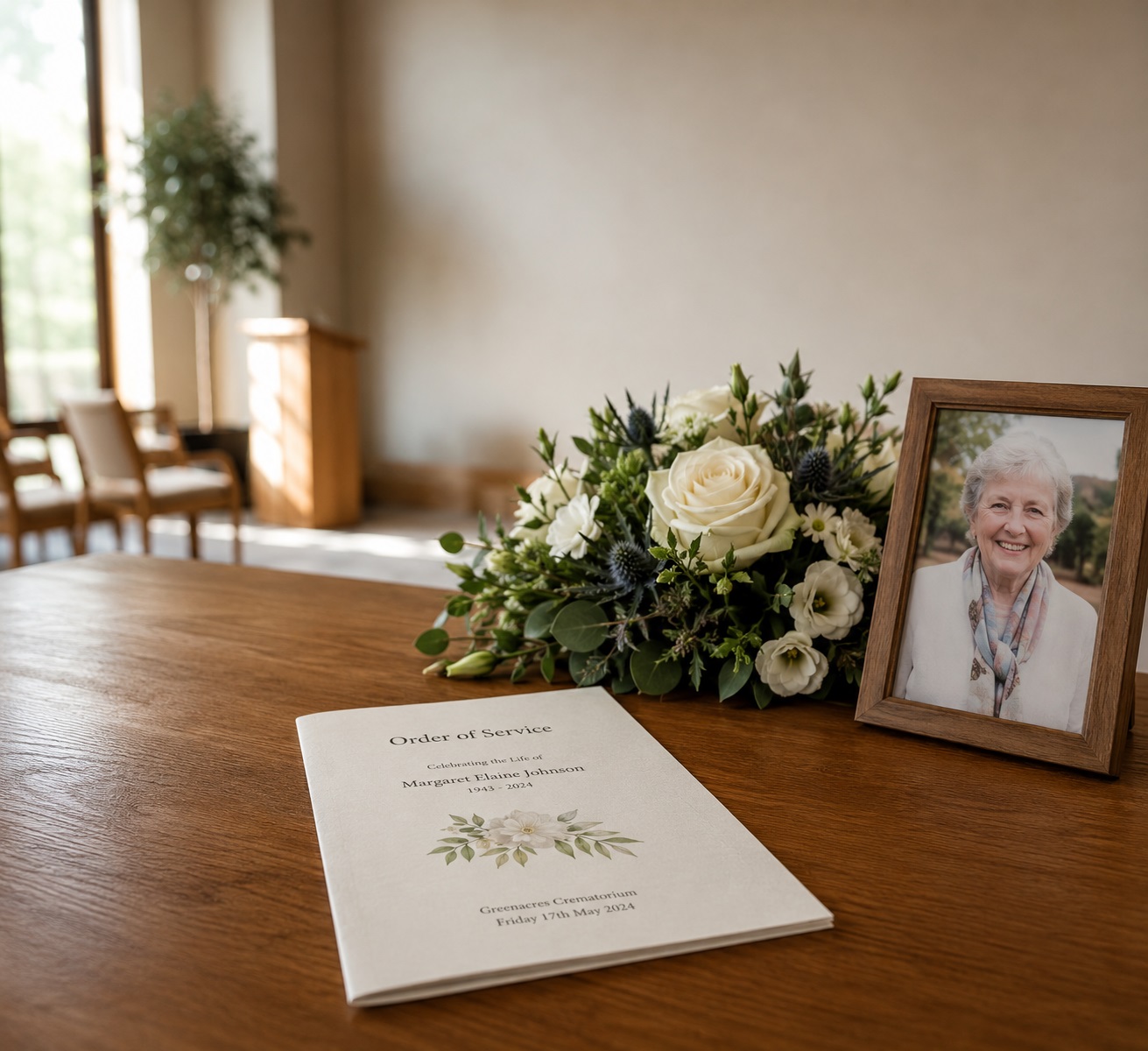
A story told properly, a photograph, a favourite song or somebody standing up and saying something that could only have been said about that person can matter far more than another product added to the invoice.

If you searched for a “cheap funeral”, look at what has actually been removed
“Cheap funeral” is an understandable thing to search.
But when comparing low-cost funeral prices, the number at the top of the page only tells you part of the story.
A low price might simply reflect a genuinely straightforward service. That can be exactly what the family wants.
But it is still worth checking the details.
Ask where the person who has died will be cared for. Check whether collection is restricted by location or time. Ask whether viewing is possible. Find out which coffin is included, whether a hearse is provided, how flexible the funeral date is, which crematorium will be used and whether ashes are returned or collected.
Also check which third-party charges have been included.
Since 2021, funeral directors have been legally required to display a Standardised Price List, including the price of an attended funeral, relevant individual elements and any unattended funeral they offer. If a family does not want one or more of the specified elements within the attended funeral, the CMA rules allow those elements to be removed and an appropriate discount applied.
That gives families something much more useful than a headline figure: a way of seeing what they are actually buying.
What costs can you reduce?
Not every part of the funeral is equally flexible.
Third-party charges such as crematorium fees or cemetery fees may largely be outside the funeral director’s control.
Other elements are much easier to adjust.
These can include the coffin, number of limousines, flowers, printed service sheets, embalming, catering, newspaper notices and some memorial choices.
SunLife’s 2026 research found that 97% of funeral directors believe families sometimes spend more than necessary, with flowers particularly commonly mentioned.
There is nothing wrong with choosing beautiful flowers or an elaborate coffin if they mean something to you.
The point is simply to choose them because you want them – not because you assumed you had to.
Tell your funeral director your budget
Money can feel awkward to talk about during funeral arrangements.
It shouldn’t.
If you have £3,000, £4,000 or another firm amount available, saying so at the beginning gives the funeral director something useful to work with.
A good funeral arrangement meeting should allow you to say:
“This is what we can comfortably afford. What can we do within that?”
That conversation may produce a much better funeral than choosing everything first and worrying about the final invoice afterwards.
The CMA introduced its funeral-pricing requirements specifically to make pricing clearer and help families choose arrangements that meet both their needs and their budget.
At Best, the aim is not to be the cheapest funeral provider. It is to give families proper local care at a fair and transparent price, with clear guidance about what is included before they commit.

Looking for a affordable funeral?
Best can connect you with a carefully selected independent local funeral director who can guide you through the options and help you arrange a funeral that feels respectful, right and affordable.
Call 0333 242 2368 or search by postcode.
Can I still have a personal funeral on a budget?
Absolutely.
Personalisation and expense are not the same thing.
A funeral can include a favourite song, family photographs, readings, handwritten messages, stories, a meaningful route, people carrying the coffin, or relatives contributing to the ceremony without dramatically increasing the cost.
Sometimes simplifying the more formal parts actually leaves more room for those personal details.
It can make the funeral feel less like following a template and more like remembering one particular person.
You can read more about personalising a funeral in our helpful guide.
What if I am struggling to pay for the funeral?
There may be financial help available.
In England and Wales, people receiving certain qualifying benefits may be able to claim a Funeral Expenses Payment.
This can help with burial or cremation fees, some travel costs, certain documents and moving the person who has died more than 50 miles where necessary. It can also provide up to £1,000 towards other funeral expenses, such as funeral-director fees, the coffin or flowers. It will not normally cover the whole funeral.
Scotland has a separate Funeral Support Payment.
Money may also sometimes be available through the estate of the person who died, insurance, a funeral plan or directly from their bank account. MoneyHelper provides further guidance on the different ways funeral costs can be met.
How Best helps you arrange an affordable funeral
The difficult part of arranging an affordable funeral is not simply finding the lowest number.
It is working out what you can safely simplify and what you really don’t want to lose.
Your Best Funeral Director can help you do that.
Best carefully selects one independent local funeral director for each defined area, looking at professional standards, people, facilities, reputation, care and local knowledge.
The funeral itself is then arranged by that local independent business rather than through a rigid national package.
That means you can talk honestly about:
- your budget;
- whether you want people present;
- burial or cremation;
- the traditions you want to keep;
- the things you are happy to simplify;
- and the personal details that matter most.
You should then receive a clear written quotation before the arrangements are agreed.

Tell us the funeral you want – and the budget you need to work within
We’ll help you understand the choices and arrange a funeral that feels right without adding things simply because they are available.
Call Best now on 0333 242 2368 or enter your postcode to see the local Best Funeral Director selected for your area.
Frequently asked questions about affordable funerals
Families looking for an affordable funeral are usually trying to balance two things: keeping the costs manageable and still arranging a goodbye that feels right. These are some of the questions people most commonly have.
Q: What is the cheapest type of funeral?
A: Direct cremation is generally the lowest-cost mainstream funeral option. 2026 research puts the UK average at £1,628, compared with £3,518 for a simple attended cremation. A direct cremation does not include an attended funeral service at the crematorium.
Q: Can I have an affordable funeral with family and friends present?
A: Yes. A simple attended funeral can allow everyone to attend while reducing some of the traditional extras that increase the overall cost. A simple attended cremation currently averages £3,518 nationally.
Q: Is a simple funeral the same as a direct cremation?
A: No. A simple attended funeral still includes an attended ceremony. A direct cremation takes place without mourners present at the crematorium.
Q: How can I reduce funeral costs?
A: Start by deciding which parts of the funeral matter most, then look at optional spending around them. A simpler coffin, fewer vehicles, modest flowers, a home wake and fewer printed materials are common ways families reduce costs.
Q: Can I remove things from an attended funeral?
A: Potentially. Under the CMA’s Standardised Price List rules, if you do not want one or more elements included within the specified attended funeral, the funeral director may remove them and apply an appropriate reduction.
Q: Are cheaper funerals less dignified?
A: They do not have to be. Cost and dignity are not the same thing. Professional care, respectful handling and good communication should remain important regardless of whether the ceremony itself is simple or elaborate.
Q: Can I tell the funeral director exactly what my budget is?
A: Yes. It can make the arrangements much easier. A funeral director can explain which costs are fixed, which are optional and where changes can be made without removing the parts of the funeral that are most important to you.
Q: Can I get financial help with funeral costs?
A: Possibly. Funeral Expenses Payment is available to some people receiving qualifying benefits in England and Wales and can contribute towards specified funeral costs, including up to £1,000 towards certain other expenses. Scotland operates a separate Funeral Support Payment.
Arrange an affordable funeral with Best
Affordable does not have to mean impersonal.
It does not have to mean choosing the cheapest possible provider or removing everything that makes the funeral meaningful.
Often it simply means knowing your priorities, understanding the quotation and spending your money where it matters most.
Best can connect you with the carefully selected independent local Best Funeral Director for your area, who can talk through your budget and help create a funeral around the needs of your family.
Call Best on 0333 242 2368, or enter your postcode to find the Best Funeral Director for your area.